
Malbeconomics
Taking stock of the twentieth anniversary of the 9.99 price point

6-MINUTE READ
‘It’s been a long time…’
Twenty years ago this month, the floodgates of on-demand music burst open. As pundits questioned whether fans would pay for recently launched services like Rhapsody and Real Networks, new entrants from America Online and a joint venture between Sony and Vivendi joined the fray. Each offered customers varying menus of song downloads and streams, and all charged a monthly fee of just $9.99 – still the dominant price in Dollars, Euros and Sterling. (Economists will be quick to point out that America gets music cheap, but often fail to acknowledge they don’t have VAT eating into the licence base hence no worse off).
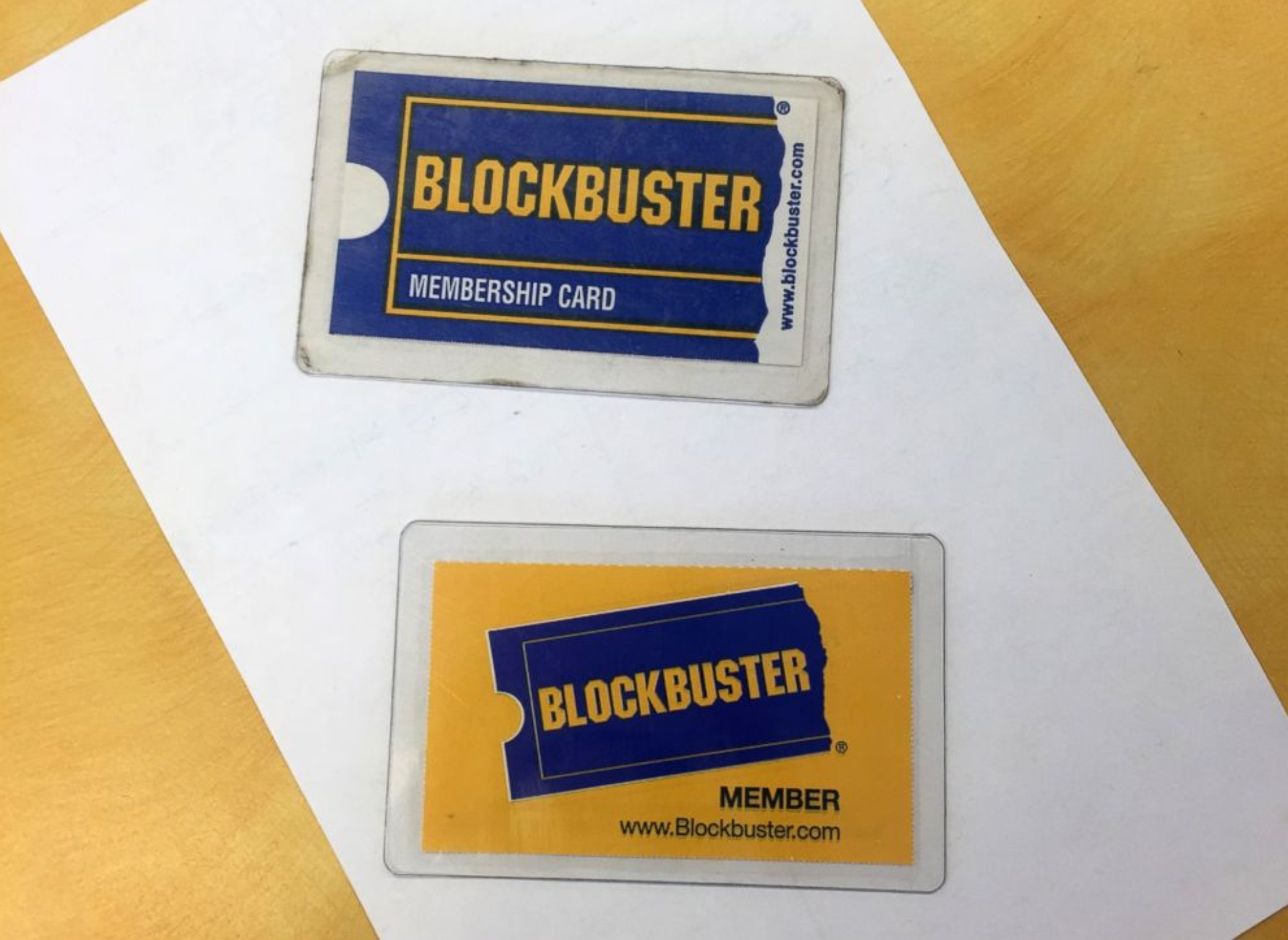
The origins of this 9.99 price point are disputed. Some allude to the “charm pricing” technique purporting that bills ending in 99 feel more than one cent cheaper than the next highest integer. Others say the number was set to mirror the cost of a Blockbuster rental card. Whatever its true genesis, the two-decades old 9.99 price point is the missing note for the ongoing chorus of debate about how much music is worth and what it should cost.
The UK price isn’t right
Transatlantic price comparisons matter; as over in the UK it’s getting political.
A Parliamentary inquiry which kicked off late last year has led to the prospect of Britain’s competition and intellectual property regulators upending the economics of music streaming in an attempt to more fairly reward performers and creators. Worryingly, given the divisive nature of the year-long debate about music streaming economics, a constructive conversation about something as important as price has been lacking throughout the process.
Britain was late to the streaming party, but early to adopt it en masse – with Spotify launching its £9.99 offering there in February 2009, almost a decade after the aforementioned US services landed on the late Netscape browser. Spotify’s European rollout came soon after – again at €9.99 – with the long awaited US launch following in July 2011 at (you guessed it) $9.99.
A stable price point of 9.99 has benefits for consumers. All else equal, as incomes rise, more listeners should be willing to pay a fixed fee. But it also comes with inflationary costs – especially to the artists and songwriters.
The Office of National Statistics offers three metrics that are pertinent to the cost of music streaming. CPI captures everything bar housing costs like mortgages; CPI Services exclude all goods, so no shopping nor petrol; finally, our preferred metric of Household Consumption excludes savings and capital expenditure but does capture banking fees and even gambling!
Using any of the three metrics British wonks use to calculate inflation shows a stark deflationary impact on Spotify’s persistent price since its British launch. Depending on which costs the calculations discard, the value of the sacred 9.99 has fallen by almost 13% using the Household deflator, 22% using the headline CPI measure and 29% to just £7.10 when the more aggressive CPI services metric is applied.
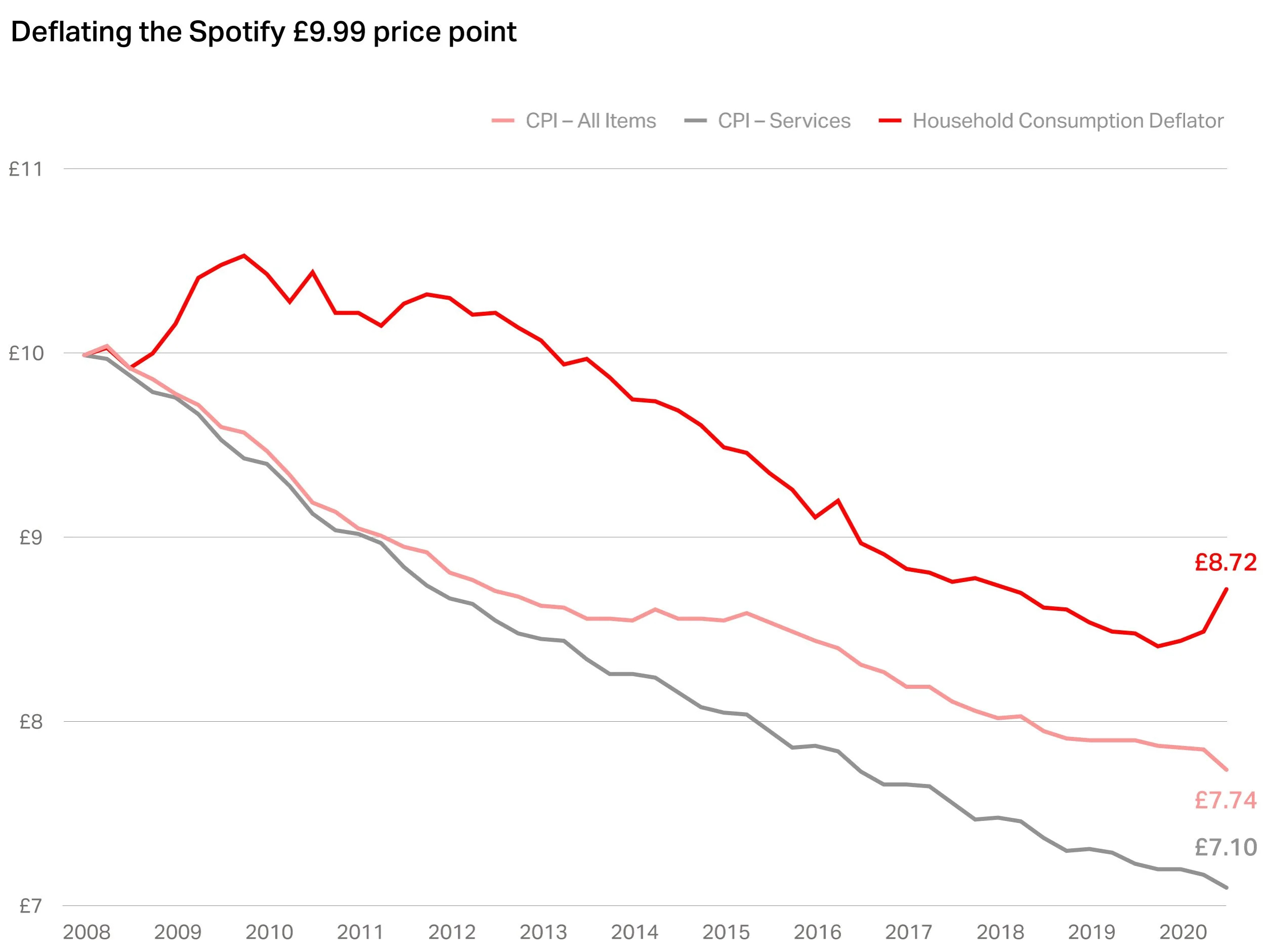
Whether this is good or bad depends on perspective. On one hand, the falling price in real terms has eroded the incomes of artists and songwriters. But it has also galvanised significant growth, as total consumer spending on music subscriptions rose more than twelve-fold between 2013 and 2021, to £1.2bn – a success story that’s been reflected around the world. Few industries can claim that success. Price may explain it.
We are family
The plot thickens when factoring in Spotify’s family plan, which it launched in the UK in 2014 with little initial uptake. But when Apple Music launched on iPhones in the second half of 2015, with a family plan offered upfront, the proposition of £14.99 for six accounts went mainstream. Assuming 2.3 people per family plan equates to £6.50 per account, and the student plan, launched in 2014, reduced that price further still, to £4.99 – all before adjusting for inflation.
Now the calculations get complicated. Accounting for these varying price points across the three major services of Apple Music, Amazon Music Unlimited and Spotify, with a blended and weighted calculation, deflates the 9.99 shibboleth to just £6.30 after adjusting for inflation.
That’s worth thinking (and drinking) about.
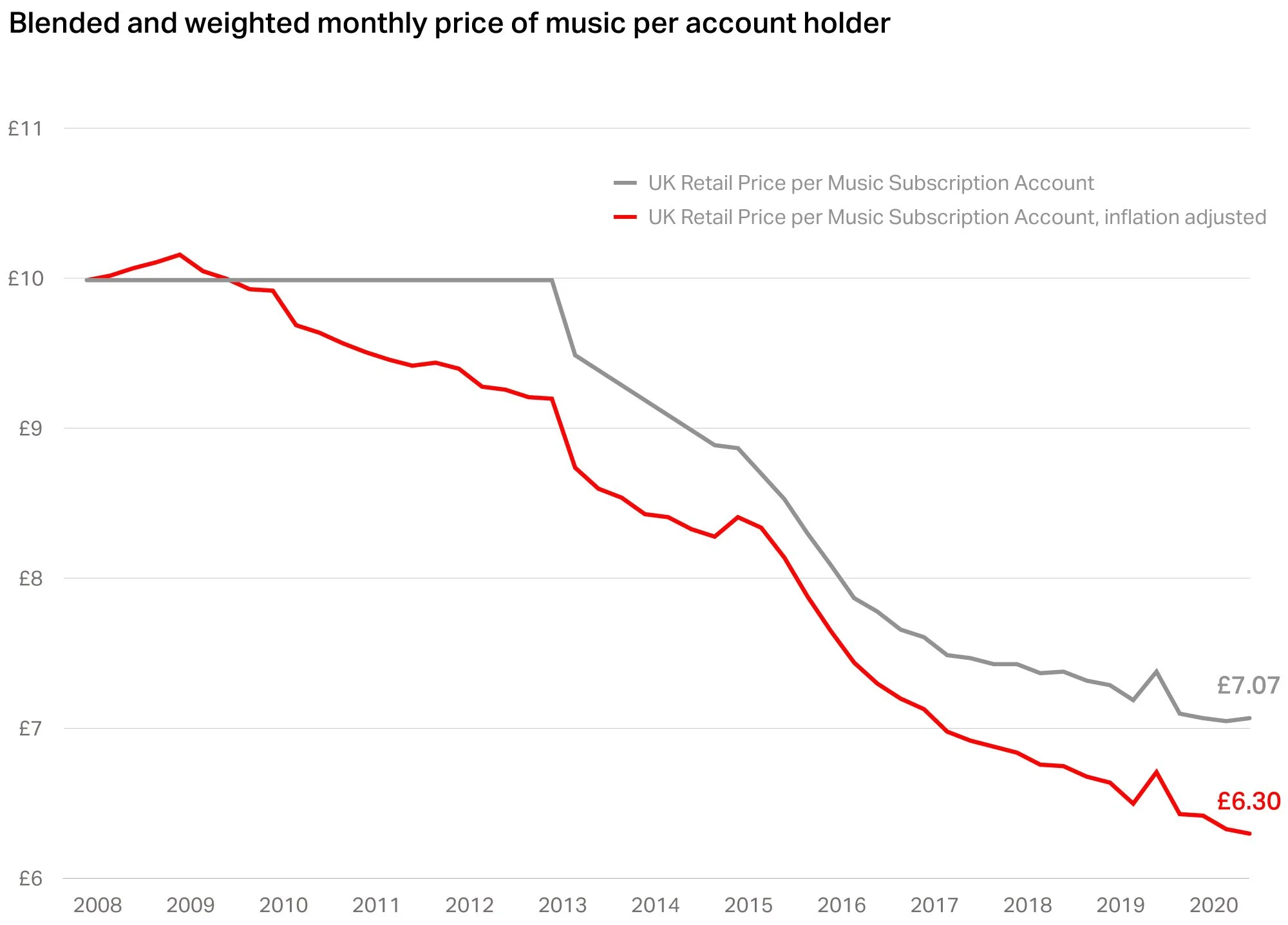
Let’s take a time out as this gets very hypothetical – after all $9.99 today is worth, well, $9.99 today! What the red line tells us is that the average ‘weighted-subscriber’ across all three major services and across all three pricing plans would have seen the ‘blended cost’ of their subscription fall by over a third (35%), from £9.99 to just £6.30.
There’s a message in a bottle
Let’s digress.
Economists love stripping inflation out of data like a kid playing with a new toy. Click bait headlines of artists suffering pay cuts miss the point; the business is growing and this is only loosely linked to the hotly debated ‘per stream’ metric – after all, pay more for a streaming service and (subsequently) streaming even more music and you drive the per stream down.
To make a constructive contribution to the conversation about price, we need to ‘uncork’ a comparator, so let’s pour our first glass of ‘Malbeconomics’.
Malbec (‘bad beak’) originated from France, but Argentines quickly noted that Malbec (and lesser known Torrontés) grapes thrived in their climate and put a lot of effort into their promotion. Torrontés never took off, whereas Malbec’s heavy dark colour and rustic rugged appeal made it a mainstay of menus. Connoisseurs noted that, unlike comparable wines, it didn't leave a soft silky lingering flavour in the mouth thanks to black currant cassis and firm but integrated tannins. That was the taste of success – Malbec now ranks in the top ten most popular wines in the world.
Malbec’s success has been captured in the rising prices consumers are willing to pay. Kevin O’Rourke, a wine industry expert and founder of Wineman, found that across all sizes, from a small glass to a bottle, the price you’d pay in today’s restaurant for an ‘entry level’ Malbec Michel Torino Colección Estate has doubled since 2009.

Cheers. Why is music offering more for the same, whereas wine offers the same for more?

To the reader, the link between rock and roll and alcohol may not be immediately apparent.
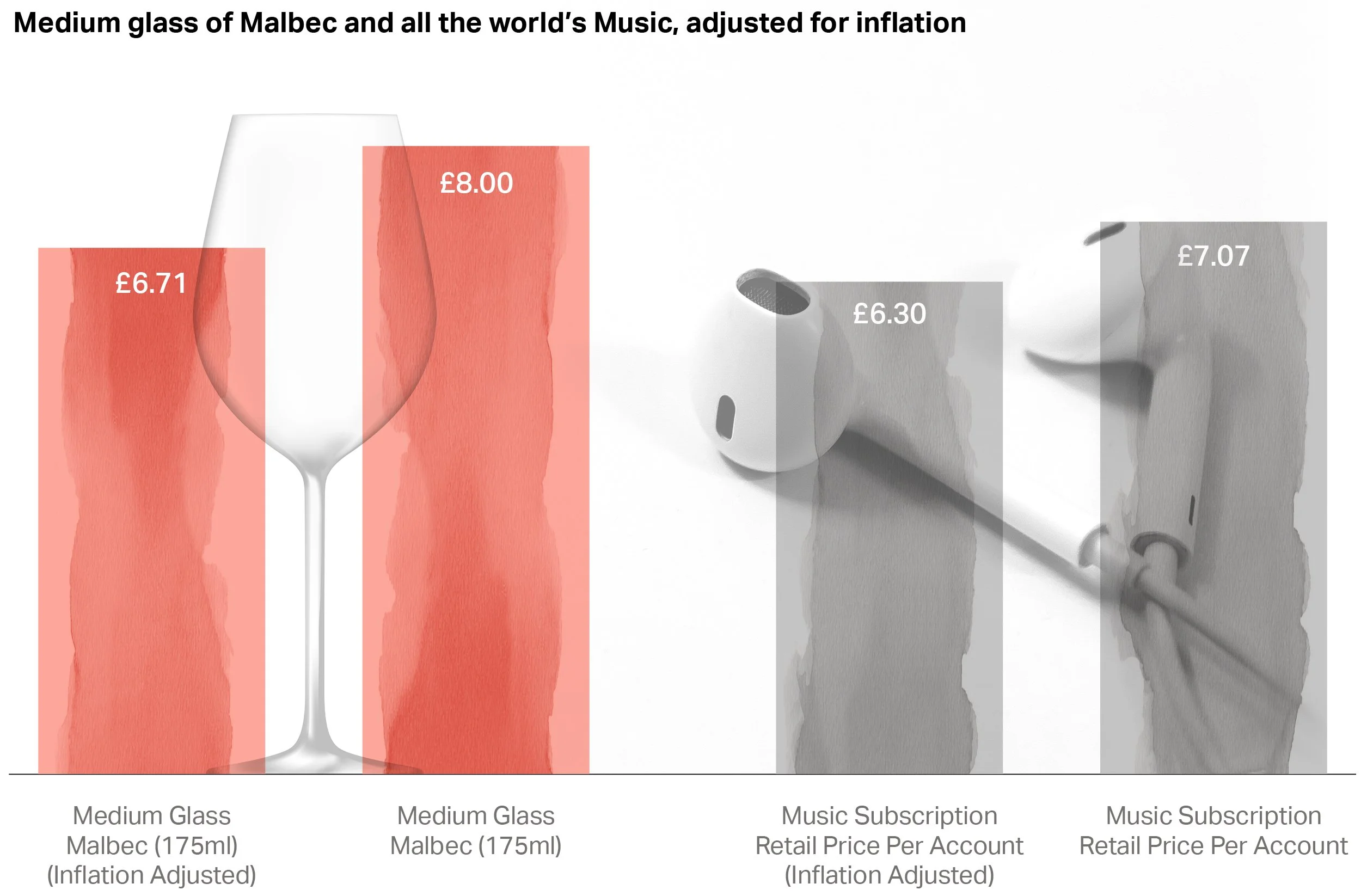
As the chart below shows, a medium glass (175ml) of Malbec now costs more than the blended price of accessing 75 million songs on a music streaming service, in both nominal and real terms. If a consumer were to have done only two things in their life since the start of 2009, drinking Malbec and streaming music, (not entirely implausible), today it would ‘feel’ like the latter is cheaper than the former.
Statisticians actually spend a lot of time thinking about exactly this sort of stuff: not wine nor music, per se, but how to factor in service improvements when price remains constant. Using a technique called Hedonic Pricing – not to be confused with the price of living wild in the disco era! Stattos like to adjust for (say) the price of computers – the price remains unchanged, but you got a better chip and more RAM, so they need to factor this into the deflator. My book Tarzan Economics explores ‘Bezos Law’, which states ‘a unit of [cloud] computing power price is reduced by 50 per cent approximately every three years’ – requiring a more aggressive deflator as firms are getting more for it.
Today, on the twentieth anniversary of the 9.99 price point, streaming’s service-improvements have skyrocketed, despite its price remaining unchanged. Song volumes have climbed from just 15,000 tracks on Rhapsody’s 2001 offering to over 75m today (growing at a rate of 75,000 a day). Smartphone streaming apps make these massive libraries imminently accessible, and are constantly being improved. Single accounts have given way to flexible plans with collaborative listening options. And, since the 2015 breakthrough of algorithmic playlists like Discover Weekly, services can even choose the music for you. Yet, the price for music remains not just the same, but cheaper when adjusted for all the participants in the family plan, student pricing and inflation.
Meanwhile, a 175ml glass of Malbec comes from the same grape, packs the same alcohol content and is served at the same volume, yet its face value price has doubled. Indeed it's true to say it hasn’t changed one millilitre! Wine is offering the same for more, whereas music is offering far more, for far less.
How long can the song remain the same? The tug-of-war over label profits and artist payouts needs to grapple with the historic decision twenty years ago to mirror the cost of music to a Blockbuster rental card. The thorny conversation that should follow, ideally over a round or two of Malbec, is for the artists, executives, politicians and their policy makers to thrash out why this continues to be the case in the UK, US and Eurozone alike, and when (not if) this should change.
Cheers!
Acknowledgements
Acknowledgements: Luke Croydon, Andrew Walton, Katherine Kent, Chris Payne and Philip Gooding at the Office of National Statistics; Kevin O’Rourke at Wineman; Nick Lightle for his ‘priceless’ modelling skills; Ralph Simon (Mobilium); Luke Butler at the Entertainment Retailers Association; Dr. Hayleigh Boscher (Brunel University); Stuart Dredge at Music Ally; special thanks to Jez Bell, Chief Licensing Officer at PPL who first alerted me to the pricing conundrum way back in the fourth quarter of 2008. Hat tips to wordsmith Sam Blake for copy editing and Alice Clarke for design.
